
a

Blog

How to Recover Lost, Forgotten, and Unclaimed Shares of United Spirits Limited

How to Recover Lost, Forgotten, and Unclaimed Shares of United Spirits Limited

26, Aug 2026

United Spirits Limited (USL) is one of India's leading beverage alcohol companies and a prominent manufacturer, marketer, and distributor of premium spirits. With a diverse portfolio that includes whisky, vodka, rum, gin, and brandy, the company has established a strong presence across domestic and international markets.

Headquartered in Bengaluru, United Spirits has built a legacy spanning decades and is known for several iconic brands that have become household names in India. The company operates an extensive manufacturing and distribution network, serving millions of consumers across the country. As part of the global beverage leader Diageo, United Spirits combines international expertise with a deep understanding of the Indian market.

As a publicly listed company, United Spirits Limited has a large shareholder base. Over the years, due to reasons such as change of address, lost share certificates, unclaimed dividends, inactive Demat accounts, or lack of awareness among legal heirs, many investors have lost track of their shareholdings.

In such cases, shares and dividends may eventually be transferred to the Investor Education and Protection Fund (IEPF), if they remain unclaimed for the prescribed period. Fortunately, eligible shareholders and their legal heirs can initiate the recovery process by following the applicable regulatory procedures.

Historical Data on the Shares Issued by United Spirits Limited

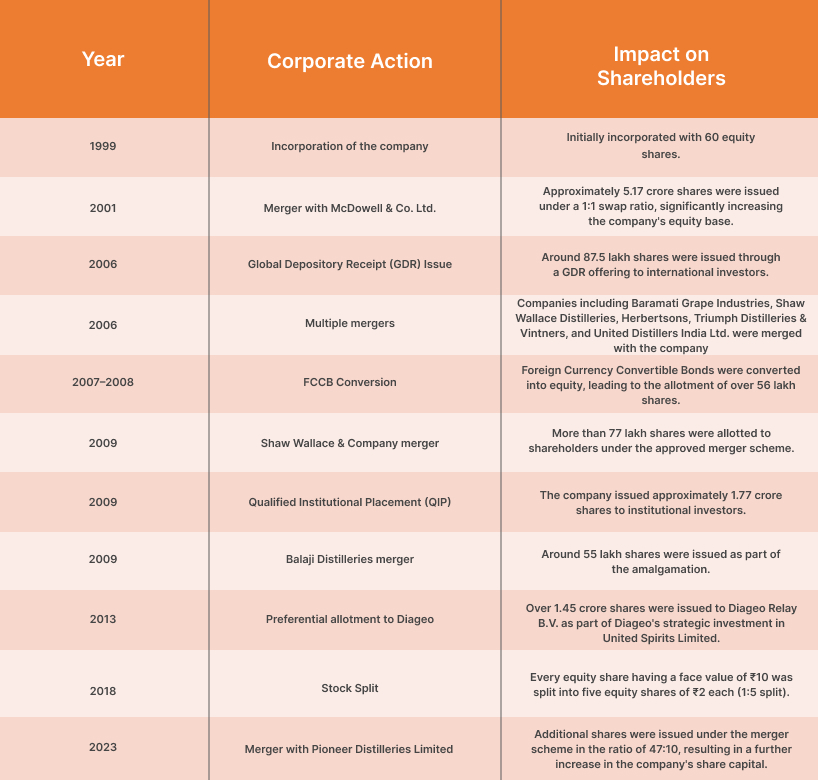
Understanding the share capital history of United Spirits Limited (USL) is essential for shareholders who are trying to recover lost, forgotten, or unclaimed shares. Over the years, the company has undergone several mergers, allotments, share issuances, and corporate restructuring exercises that have significantly changed the number of shares in circulation. Investors holding old physical share certificates may find that the number of shares they originally owned has changed because of these corporate actions.

Below is an overview of some of the major milestones in the company's share capital history:
Why This Matters for United Spirits Limited Shareholders

Many investors purchased United Spirits shares decades ago when share certificates were issued in physical form. Since then, the company's mergers, share issuances, and the 2018 stock split may have altered the number of shares they are entitled to today. If these shares were never dematerialized, dividends remained unclaimed for seven consecutive years, or investors lost track of their holdings, the shares may have been transferred to the Investor Education and Protection Fund (IEPF).

Before initiating an IEPF claim or requesting duplicate share certificates, shareholders should carefully verify their original folio number, share certificate details, and any corporate actions that may have affected their holdings. Having a clear understanding of United Spirits Limited's share history can make the recovery process significantly smoother and help ensure that the correct number of shares is claimed.

Billions in Unclaimed Investments Are Waiting to Be Recovered

A substantial amount of investor wealth remains unclaimed with the Investor Education and Protection Fund (IEPF). As per the latest available data, the IEPF Authority holds over 117 crore unclaimed shares and more than ₹8,200 crore in unpaid dividends belonging to investors and their legal heirs.

If dividends on your shares have remained unclaimed for seven consecutive years, your shares may have been transferred to the IEPF in accordance with regulatory requirements. The good news is that these investments can still be recovered. By understanding the IEPF claim process and following the necessary steps, eligible shareholders and legal heirs can reclaim their unclaimed shares and dividends.

How to Recover Lost, Forgotten, and Unclaimed Shares of United Spirits Limited

Check Whether Your Shares Have Been Transferred to the IEPF

The first step is to verify whether your United Spirits Limited shares have been transferred to the Investor Education and Protection Fund (IEPF). Under the Companies Act, 2013, shares and unpaid dividends are transferred to the IEPF if dividends remain unclaimed for seven consecutive years. Once transferred, you must file an IEPF claim with the IEPF Authority to recover your shares and dividends, as the company can no longer process the claim directly.

How to Check if Your United Spirits Limited Shares Have Been Transferred to the IEPF

To verify whether your United Spirits Limited shares have been transferred to the Investor Education and Protection Fund (IEPF), visit the company's Investor Relations section, where it periodically publishes the list of shareholders whose unpaid dividends and corresponding shares have been transferred to the IEPF Authority. You can search the records using your name, folio number, DP ID, or Client ID. If your details appear in the list, it means your shares and any associated unpaid dividends have been transferred to the IEPF.

You can also verify the status of your unclaimed shares and dividends through the IEPF Authority's online portal. If you require further assistance, you may contact United Spirits Limited's Registrar and Transfer Agent (RTA) or the company's IEPF Nodal Officer. They can help confirm the transfer status and guide you through the process of recovering your shares and unpaid dividends from the IEPF.

Gather the Required Documents for Your IEPF Claim

Before filing an IEPF claim for your United Spirits Limited shares, ensure that you have the necessary documents ready. Depending on the nature of your claim, you may need:

  • Entitlement Letter issued by United Spirits Limited or its Registrar and Transfer Agent (RTA)
  • Aadhaar Card
  • PAN Card
  • Passport, OCI Card, or PIO Card (where applicable)
  • Corporate Identification Number (CIN) of United Spirits Limited
  • Folio Number and Demat Account details
  • Bank account details (cancelled cheque or passbook copy, if required)
  • Indemnity Bond and Affidavit
  • Original share certificate(s), if available
  • Succession Certificate, Probate, or Will (for claims by legal heirs)
  • Death Certificate of the shareholder (where applicable)
  • No Objection Certificates (NOCs) from other legal heirs, if applicable

Keeping these documents complete and accurate before initiating your claim can help streamline the IEPF recovery process and minimize delays.

Submit Form IEPF-5 on the MCA Portal

After gathering the required documents, file Form IEPF-5 through the MCA portal to initiate your claim for United Spirits Limited shares. Ensure that all details—including your name, folio number, DP ID/Client ID, bank account information, and shareholding details—accurately match the records maintained by the company and its Registrar and Transfer Agent (RTA).

Review the form carefully before submission, as any discrepancies may result in delays or additional documentation requests.

Send the Physical Documents to United Spirits Limited

After submitting Form IEPF-5 online, print the completed form and send it along with the required supporting documents to the IEPF Nodal Officer of United Spirits Limited or its Registrar and Transfer Agent (RTA). Mention "Claim for Refund from IEPF Authority" on the envelope for easy identification.

The document set generally includes:

  • Duly signed copy of Form IEPF-5
  • SRN acknowledgement generated after online submission
  • Original Indemnity Bond
  • Original Advance Stamped Receipt
  • Proof of share ownership (physical share certificates or Demat account statement)
  • Self-attested copies of Aadhaar Card and PAN Card
  • Cancelled cheque or bank passbook copy
  • Demat Client Master List (CML), where applicable
  • Passport, OCI Card, or PIO Card (for NRI/foreign claimants)
  • Succession documents, death certificate, or other legal documents, if applicable

Before dispatching the documents, ensure that they are complete, signed, and self-attested wherever required. It is also advisable to keep copies of the entire document set and the courier or postal receipt for future reference.

Verification by United Spirits Limited and Processing by the IEPF Authority

Once your physical documents are received, United Spirits Limited and its Registrar and Transfer Agent (RTA) verify the details against the company's shareholder records. After successful verification, a verification report is submitted to the Investor Education and Protection Fund (IEPF) Authority for further processing.

The IEPF Authority then reviews the claim and supporting documents. If everything is found to be in order, it approves the claim and authorizes the release of the shares and any eligible unpaid dividends.

Upon approval, the recovered shares are credited to the claimant's Demat account, while the approved dividend amount is transferred directly to the registered bank account. Since the IEPF recovery process involves multiple documents and strict compliance requirements, many investors seek professional assistance to ensure accurate filing and avoid unnecessary delays.

Why Consider Professional Share Recovery Services?

Recovering shares from the IEPF can be a lengthy and document-intensive process. Even minor issues—such as name discrepancies, signature mismatches, outdated records, or incomplete documentation—can delay the processing of your claim.

The process can be even more complex for legal heirs claiming shares on behalf of a deceased shareholder. In such cases, additional documents, such as succession certificates, probate, legal heir certificates, or other supporting records, may be required. If any of these documents are missing or need to be reissued, the recovery process can take significantly longer.

Professional share recovery services can help assess the eligibility of your claim, identify documentation gaps, coordinate with the company and its Registrar and Transfer Agent (RTA), and ensure that your IEPF application is complete and accurate. Since investors can typically submit only one IEPF claim per company in a financial year, filing a well-prepared claim can help minimize delays and improve the chances of a successful recovery.

Conclusion

Recovering lost, forgotten, or unclaimed investments can be a complex process, especially when it involves IEPF claims, missing documents, legal heir cases, or old physical share certificates. Rather than navigating multiple procedures on your own, you can rely on the expertise of Share Samadhan, one of India's leading share recovery firms.

Our experienced team assists investors and legal heirs with a wide range of share recovery services, including:

  • Recovery of shares transferred to the IEPF
  • Lost and forgotten share recovery
  • Duplicate share certificate issuance
  • Transfer and transmission of shares
  • Dematerialisation of physical shares
  • Recovery of unpaid dividends
  • Share tracing and ownership verification

When you contact Share Samadhan, our experts first evaluate your case to determine the best course of action. If your case is accepted, you will be assigned a Dedicated Relationship Manager who will guide you through every stage of the recovery process—from document collection and verification to filing the claim and coordinating with the company, its Registrar and Transfer Agent (RTA), and the IEPF Authority.

We also specialize in assisting Non-Resident Indians (NRIs). Whether your shares are lying with the IEPF, or you need duplicate share certificates, or you want to trace old investments, our team can manage the process remotely. In most cases, NRIs do not need to travel to India, as the documentation, coordination, and claim process can be handled efficiently through online and courier-based communication.

If you believe you or your family owns lost, forgotten, or unclaimed United Spirits Limited shares, don't let your investments remain idle. Reach out to Share Samadhan today and let our experts help you reclaim what rightfully belongs to you.

Frequently Asked Questions (FAQs)

1. How can I convert my physical share certificates into Demat form?

To dematerialize your physical shares, you need to open a Demat account with a registered Depository Participant (DP) and submit a Dematerialisation Request Form (DRF) along with your original share certificates. If there are discrepancies in the records, professional assistance can help resolve them and complete the process smoothly.

2. I have lost track of my old share investments. Can they still be traced?

Yes. Even if you have misplaced your share certificates or forgotten your investments, old shares can often be traced using details such as your name, PAN, folio number, or other available records. Once identified, the appropriate recovery process can be initiated.

3. How do I recover shares that have been transferred to the IEPF?

If your dividends remained unclaimed for seven consecutive years, your shares may have been transferred to the Investor Education and Protection Fund (IEPF). You can recover them by filing Form IEPF-5, submitting the required documents, and completing the verification process with the company and the IEPF Authority.

4. What should I do if my physical share certificate is lost or damaged?

If your original share certificate has been lost, stolen, or damaged, you can apply for a duplicate share certificate through the company or its Registrar and Transfer Agent (RTA). The process typically requires identity proof, an indemnity bond, and other supporting documents.

5. What is the difference between transfer and transmission of shares?

Transfer of shares is the voluntary transfer of ownership from one living person to another, usually through a sale or gift. Transmission of shares, on the other hand, occurs due to the death of a shareholder, where the shares are transferred to the legal heir or nominee after the required legal formalities are completed.

What is the procedure for share transmission?

Share transmission is the process by which the ownership of shares is transferred to a nominee or legal heir following the death of a shareholder. Since it occurs by operation of law, it does not require a share transfer deed.

The procedure for share transmission generally involves the following steps:

  • 1. Notify the Company or RTA:
    The nominee or legal heir should inform the company or its Registrar and Transfer Agent (RTA) about the shareholder's death and request the prescribed transmission application form.
  • 2. Collect the Required Documents:
    The claimant must gather all the documents needed to support the request. These usually include the death certificate of the shareholder, the original share certificate (for physical shares), identity and address proof of the claimant, and legal documents such as a succession certificate, probate of will, legal heir certificate, or letters of administration, depending on the case. The company may also ask for an affidavit, indemnity bond, or other supporting documents.
  • 3. Submit the Transmission Request:
    The completed transmission form, along with all required documents, should be submitted to the company or its RTA for processing.
  • 4. Verification of the Claim:
    The company examines the documents to confirm the claimant's identity and legal entitlement to the shares. If any information is missing or additional proof is required, the claimant may be asked to provide further documents.
  • 5. Approval of the Transmission:
    Once the verification process is completed successfully, the company approves the request and records the name of the nominee or legal heir as the new shareholder in its Register of Members.
  • 6. Update of Shareholding Records:
    After approval, the company updates its records and completes the transmission. For shares held in physical form, a new share certificate may be issued in the name of the claimant. If the shares are held in demat form, they are credited to the claimant's demat account.

The exact documentation and requirements may vary depending on the company's policies, the value of the shares, and whether the deceased shareholder had appointed a nominee or left a valid will.

How to claim unclaimed dividend?

If you have an unpaid or unclaimed dividend, you can recover it by following the prescribed process. The steps vary depending on whether the dividend is still with the company or has already been transferred to the Investor Education and Protection Fund (IEPF). Unclaimed dividends for 7 consecutive years are transferred to the IEPF.

1. Verify Whether the Dividend Is Unclaimed

Start by checking whether any dividend is pending in your name. You can do this using your Folio Number (for physical shares) or DP ID and Client ID (for demat shares) on the Registrar and Transfer Agent's (RTA) investor portal.

2. Submit a Request to the Company or RTA

If the dividend has not yet been transferred to the IEPF, submit a claim to the company's Registrar and Transfer Agent. Your application should include details such as your shareholder information, folio number or demat account details, the relevant financial year, and your contact information.

3. Provide the Required Documents

To process your request, you will generally need to submit supporting documents, including:

  • A self-attested copy of your PAN card.
  • A cancelled cheque with your name printed on it for bank verification.
  • Client Master List (for shares held in demat form), if applicable.
  • Any additional forms or declarations required under the applicable SEBI guidelines.

4. Verification of the Claim

After receiving your application, the company or its RTA will verify the details and supporting documents. If all information is accurate and complete, your claim will be approved for payment.

5. Receive the Dividend

Once the verification is completed, the unpaid dividend is credited to your registered bank account or paid through the mode specified by the company.

6. If the Dividend Has Been Transferred to the IEPF

When a dividend remains unclaimed for seven consecutive years, it is transferred to the Investor Education and Protection Fund (IEPF) along with the related shares. In such cases, the claim must be filed with the IEPF Authority by submitting Form IEPF-5 along with the required supporting documents. The company will verify the claim before the IEPF Authority processes the refund.

Tip: Keep your PAN, bank account details, email address, mobile number, and nomination details updated with your company or depository participant. This helps ensure that future dividends are credited on time and do not become unclaimed.

How to find lost investments?

Many investors lose track of their investments over time due to changes in address, forgotten folio numbers, misplaced share certificates, or the death of the original investor. Fortunately, these investments can often be traced with the right approach.

Here are the steps to find lost investments:

1. Gather Available Information

Start by collecting any details you have about the investment, such as:

  • Name of the company.
  • Old share certificates or dividend warrants.
  • Folio number or shareholder reference number.
  • PAN, Aadhaar, or other identity documents.
  • Bank statements showing dividend credits.

Even partial information can help in locating the investment.

2. Check Your Demat Account

If your shares have been dematerialised, log in to your demat account to view your current holdings. Your depository participant (DP) can also help you access your investment records.

3. Contact the Company's Registrar and Transfer Agent (RTA)

If you believe the shares are still held in physical form, contact the company's Registrar and Transfer Agent (RTA). Provide your available details, such as your name, PAN, or folio number, to help them trace your records.

4. Search for Unclaimed Shares and Dividends

Many companies publish details of unclaimed shares and dividends on their websites. You can also check the Investor Education and Protection Fund (IEPF) portal to see if your shares or dividends have been transferred to the IEPF after remaining unclaimed for several years.

5. Review Old Financial Records

Look through old income tax returns, bank statements, investment files, dividend warrants, or correspondence from companies. These documents often contain valuable information, such as company names, folio numbers, or transaction details.

6. Check with Depositories

If you are unsure where your investments are held, you can contact your depository participant or check your records with the depositories where your securities are maintained.

7. Seek Professional Assistance

If the investment records are incomplete, the company has merged or changed its name, or the shares have been transferred to the IEPF, you may consider taking help from professionals who specialise in tracing and recovering lost investments like Share Samadhan.

Finding lost investments may take some time, but it is often possible with the right documents and proper verification. Keeping your contact details updated, maintaining digital records, and regularly reviewing your investment portfolio can help prevent investments from becoming unclaimed in the future.

How to find unclaimed shares?

Unclaimed shares are shares that have remained inactive for several years because the shareholder could not be contacted, dividends were not claimed, or the shares were transferred to the Investor Education and Protection Fund (IEPF). If you think you have forgotten or inherited investments, you can trace them by following these steps.

1. Search Your Investment Records

Begin by checking any documents related to your investments, such as:

  • Old share certificates.
  • Dividend warrants.
  • Demat account statements.
  • Bank statements showing dividend payments.
  • Income tax records or investment files.

These documents may contain important details like the company name or folio number.

2. Contact the Company or Its Registrar and Transfer Agent (RTA)

If you know the company in which the shares were purchased, contact its Registrar and Transfer Agent (RTA). By providing your name, PAN, folio number, or other available information, the RTA may be able to locate your shareholding records.

3. Check Your Demat Account

If the shares have already been converted into electronic form, log in to your demat account to review your holdings. Your depository participant (DP) can also help you verify your investments.

4. Search the IEPF Database

If dividends on the shares have remained unclaimed for seven consecutive years, both the unpaid dividends and the related shares may have been transferred to the Investor Education and Protection Fund (IEPF). You can search the IEPF records using your name or the company's details to determine whether your shares have been transferred.

5. Verify Corporate Changes

If the company has merged, changed its name, or been acquired, your shares may now be held under a different company name. Checking the company's corporate history can help you trace your investment.

6. Recover the Shares

Once you locate the unclaimed shares, follow the company's or the IEPF Authority's prescribed process to reclaim them. You may be required to submit identity proof, ownership documents, and other supporting records for verification.

Tracing unclaimed shares is easier when you have supporting documents, but even if some records are missing, you may still be able to recover your investments by contacting the company, its RTA, or the IEPF Authority. Keeping your contact details, PAN, bank information, and nomination details updated can help prevent your shares from becoming unclaimed in the future.

How to Find Old Shares of a Deceased Relative?

If a family member has passed away, they may have left behind investments that are unknown to the legal heirs. These old shares can often be traced, even if the original documents are missing. By following the right process, you can identify and recover the investments legally.

1. Search Through Personal Documents

Start by checking the deceased person's financial records, including:

  • Old share certificates.
  • Dividend warrants.
  • Bank statements showing dividend credits.
  • Income tax returns.
  • Investment files or correspondence from companies.

These records may contain details such as the company name, folio number, or shareholder information.

2. Check Demat Account Details

If the deceased held shares in electronic form, identify their demat account. The depository participant (DP) can provide information about the holdings after verifying the legal heir's identity and supporting documents.

3. Contact the Company's Registrar and Transfer Agent (RTA)

If you know the name of the company, approach its Registrar and Transfer Agent (RTA). Provide the deceased shareholder's name, PAN, address, or any available folio number. The RTA can help verify whether shares are registered in their name.

4. Search for Unclaimed Shares

If the shares remained inactive and dividends were not claimed for several years, they may have been transferred to the Investor Education and Protection Fund (IEPF). Legal heirs can search the IEPF records using the deceased shareholder's details to determine whether the shares have been transferred.

5. Check for Corporate Changes

Many companies have merged, changed their names, or undergone restructuring over the years. If the original company no longer exists under the same name, trace its successor company to locate the shares.

6. Gather Legal Documents

To claim the shares, legal heirs generally need documents such as:

  • Death certificate of the shareholder.
  • Identity and address proof of the claimant.
  • Legal heir certificate, succession certificate, probate of will, or letters of administration, depending on the circumstances.
  • Original share certificates, if available.
  • Any additional documents required by the company or its RTA.

7. Complete the Share Transmission Process

Once the shares are located, the legal heir must apply for share transmission. After the company verifies the documents, the shares are transferred to the rightful claimant's name or demat account.

Finding old shares of a deceased relative may require patience, especially if the investments are several years old or the records are incomplete. However, with the available financial documents, assistance from the company's RTA, and the required legal documents, legal heirs can trace and recover the investments through the prescribed transmission process.

What is an IEPF shares search?

An IEPF shares search is the process of checking whether shares have been transferred to the Investor Education and Protection Fund (IEPF). Under the Companies Act, if dividends on shares remain unclaimed for seven consecutive years, the corresponding shares are also transferred to the IEPF. Investors or their legal heirs can search the IEPF database using details such as the shareholder's name, company name, or folio number to determine whether any shares are held by the IEPF. If the shares are found, they can be claimed by following the prescribed IEPF recovery process and submitting the required documents.

0 Read More
How to Recover Lost, Forgotten, and Unclaimed Shares of Berger Paints India Ltd

How to Recover Lost, Forgotten, and Unclaimed Shares of Berger Paints India Ltd

25, Aug 2026

Many investors purchased shares of Berger Paints India Ltd. decades ago when shares were issued and held in physical form. In those days, physical share certificates served as the primary proof of ownership. Over time, however, many shareholders have misplaced, damaged, or completely lost these certificates due to relocation, inheritance issues, natural wear and tear, or simply the passage of time. As a result, they often find themselves unable to establish ownership of their investments when they need to access or liquidate them.

Under current regulations, physical shares must be converted into Demat (electronic) form before they can be sold, transferred, or transmitted to legal heirs. Shareholders who have lost their original certificates must first obtain duplicate share certificates from Berger Paints India Ltd. before initiating the dematerialization process. This involves submitting various documents, identity proofs, affidavits, indemnity bonds, and complying with the company's prescribed procedures. For many investors, especially senior citizens and legal heirs, navigating these requirements can be complex and time-consuming.

Another challenge arises when dividends remain unclaimed for seven consecutive years or more. In such cases, both the unclaimed dividends and the corresponding shares are transferred to the Investor Education and Protection Fund (IEPF) Authority. Recovering these assets requires filing a consolidated IEPF claim, supported by extensive documentation and verification procedures. 

Many shareholders abandon the process midway because of procedural hurdles, missing records, or incomplete documentation. This is where Share Samadhan, one of the leading share recovery firms in Delhi, can help. Their experienced team assists investors in tracing lost holdings, obtaining duplicate share certificates, completing dematerialization formalities, and recovering lost shares and dividends transferred to the IEPF, ensuring a smooth and hassle-free claim process.

About Berger Paints India Ltd

The origins of Berger Paints can be traced back to 1760, when a young German chemist named Lewis Berger perfected the manufacturing process of Prussian Blue, one of the most sought-after pigments of the era. His pioneering work laid the foundation for a paint and pigment business in London that would eventually evolve into the globally recognized Berger brand. Over the decades, the company expanded its product portfolio and established a reputation for innovation, quality, and technical excellence across international markets.

The Indian chapter of Berger Paints began in 1923, when Mr. Hadfield established a small paint manufacturing company in Calcutta (now Kolkata). In 1947, the business was acquired by British Paints, leading to the formation of British Paints (India) Ltd. The company steadily expanded its footprint across the country through new manufacturing facilities, sales offices, and an expanding dealer network. A significant milestone came in 1969 when Berger, Jenson & Nicholson of the United Kingdom acquired the company, bringing the historic Berger legacy to India.

A defining transformation occurred in 1983 when the company was renamed Berger Paints India Limited, marking the beginning of a new era of growth and brand recognition. Under visionary leadership and continuous innovation, Berger introduced several industry-leading products and expanded into decorative paints, industrial coatings, waterproofing solutions, and construction chemicals. Today, Berger Paints stands as one of India's leading paint manufacturers, with a strong international presence, state-of-the-art manufacturing facilities, and a century-long commitment to coloring and protecting homes, industries, and infrastructure.

Historical Data on the Shares Issued by Berger Paints India Ltd

Berger Paints India Ltd. has a long history of creating shareholder value through strategic corporate actions such as bonus issues, stock splits, and rights offerings. These initiatives have not only rewarded existing investors but have also enhanced the liquidity and accessibility of the company's shares in the market. Over the years, shareholders have benefited from multiple opportunities to increase their holdings without making additional investments.

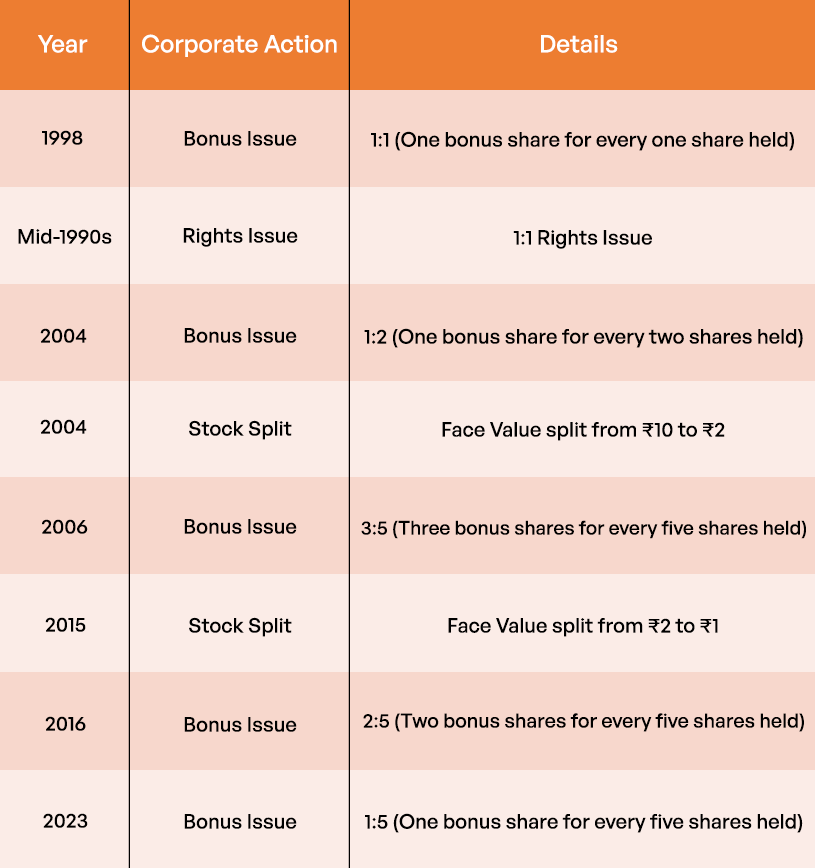
One of the key ways Berger Paints has rewarded investors is through bonus share issuances. The company has announced several bonus issues since 1998, including a 1:1 bonus issue in 1998, followed by bonus issues in 2004, 2006, 2016, and most recently in 2023. These actions substantially increased the number of shares held by long-term investors and reflected the company's confidence in its financial performance and future growth prospects.

In addition to bonus issues, Berger Paints undertook stock splits in 2004 and 2015, reducing the face value of its shares from ₹10 to ₹2 and later from ₹2 to ₹1. These measures improved market participation by making the shares more affordable to a broader base of investors. Combined with its consistent dividend history and past rights issue offerings, these corporate actions demonstrate Berger Paints' commitment to delivering long-term value to its shareholders.

Major Corporate Actions in Berger Paints India Ltd.

These corporate actions have significantly expanded the company's share capital over time, making Berger Paints one of India's most rewarding long-term wealth creators for shareholders.

How to claim unclaimed dividends and shares of Berger Paints India Ltd.

Before initiating the recovery process, it is important to determine whether your Berger Paints India Ltd. shares or unclaimed dividends have been transferred to the Investor Education and Protection Fund (IEPF) Authority.

As per the Companies Act, 2013, any dividend that remains unclaimed for seven consecutive years, along with the corresponding shares, must be transferred to the IEPF Authority. Once transferred, shareholders can no longer claim these shares or dividends directly from the company and must follow the prescribed IEPF recovery process.

To verify whether your shares have been transferred, visit the Investor Relations section of Berger Paints India Ltd.'s website. The company periodically publishes details of shareholders whose dividends and shares have been transferred to the IEPF. You can search the records using your name, folio number, DP ID, or Client ID. If your details appear in the published list, it indicates that your shares and/or dividends have been moved to the IEPF Authority.

You may also visit the IEPF Authority portal to verify the status of your unclaimed dividends and transferred shares. Alternatively, you can contact Berger Paints India Ltd.'s Registrar and Transfer Agent (RTA) or the designated IEPF Nodal Officer for assistance and confirmation.

Gather the Required Documents for Filing an IEPF Claim

Once you have confirmed that your Berger Paints India Ltd. shares or dividends have been transferred to the IEPF Authority, you must file Form IEPF-5 through the Ministry of Corporate Affairs (MCA) portal.

Before starting the application, ensure that the following documents are readily available:

  • Entitlement Letter issued by Berger Paints India Ltd. or its Registrar and Transfer Agent

  • Aadhaar Card

  • PAN Card

  • Passport, OCI Card, or PIO Card (where applicable)

  • Corporate Identification Number (CIN) of Berger Paints India Ltd.

  • Folio Number and Demat Account Details

  • Bank Account Information

  • Indemnity Bond and Affidavit

  • Succession Certificate, Probate, or Will (for claims by legal heirs)

  • Death Certificate of the shareholder (where applicable)

  • No Objection Certificates (NOCs) from legal heirs, if required

Having complete and accurate documentation can significantly improve the chances of a successful claim and reduce processing delays.

File Form IEPF-5 on the MCA Portal

After creating an MCA account and gathering all required documents, complete Form IEPF-5 online through the MCA portal. Ensure that all details entered in the form match the records maintained by Berger Paints India Ltd. and your supporting documents.

Any discrepancies in personal details, folio information, bank account details, or shareholding records may result in delays or requests for additional clarification.

Submit Physical Documents to Berger Paints India Ltd.

After successfully filing Form IEPF-5 online, print the completed form and send it along with all supporting documents to Berger Paints India Ltd.'s IEPF Nodal Officer or its Registrar and Transfer Agent. The envelope should be clearly marked "Claim for Refund from IEPF Authority."

The physical submission generally includes:

  • Signed copy of Form IEPF-5

  • SRN acknowledgement generated after online filing

  • Original Indemnity Bond executed on appropriate stamp paper

  • Original Advance Stamped Receipt signed by the claimant and witnessed by two individuals

  • Proof of ownership, such as physical share certificates or Demat statements

  • Self-attested copy of Aadhaar Card

  • Self-attested copy of PAN Card

  • Cancelled cheque bearing the claimant's name

  • Demat Client Master List (CML)

  • Passport, OCI Card, or PIO Card (for NRIs and foreign nationals)

  • Additional legal documents, where applicable

It is advisable to retain copies of all documents and courier receipts for future reference.

Verification by Berger Paints India Ltd. and Processing by the IEPF Authority

Upon receiving the claim documents, Berger Paints India Ltd. will verify the information provided by the claimant and review the supporting records. After completing its verification, the company submits a verification report to the IEPF Authority within the prescribed timeframe.

The IEPF Authority then conducts an independent review of the claim. If all documents are found to be satisfactory and the claim is approved, a refund sanction order is issued.

The approved dividend amount is credited directly to the claimant's registered bank account, while the recovered shares are transferred electronically to the claimant's Demat account. Once the process is completed, ownership of the shares and any eligible dividends is restored to the rightful shareholder or legal heir.

Since the IEPF recovery process can involve extensive documentation and procedural requirements, many investors seek professional assistance to ensure accurate filing and timely recovery of their Berger Paints India Ltd. shares and dividends.

Conclusion

Recovering shares and dividends from the IEPF Authority can be a lengthy and document-intensive process. Missing records, procedural errors, or incomplete documentation can often lead to delays and complications. Rather than navigating these challenges alone, shareholders can seek professional assistance from Share Samadhan, a trusted share recovery firm with extensive experience in handling IEPF claims, duplicate share certificate issuance, transmission of shares, and dematerialization matters.

Whether your Berger Paints India Ltd. shares have been transferred to the IEPF Authority, your share certificates have been lost, or you are claiming shares as a legal heir, Share Samadhan can guide you through every stage of the recovery process. With expert support and end-to-end assistance, you can significantly improve your chances of successfully reclaiming your rightful shares and dividends with minimal hassle.

Frequently Asked Questions 

  1. What services does Share Samadhan offer?

Share Samadhan offers assistance with IEPF claims, transfer and transmission of shares, and duplicate issue of shares. 

        2. How long does it take to recover Berger Paints India Ltd. shares from the IEPF Authority?

The timeline for recovering shares and dividends from the IEPF Authority can vary depending on the completeness of the documents submitted and the verification process carried out by Berger Paints India Ltd. and the IEPF Authority. In most cases, the process may take several months from the date of filing Form IEPF-5.

        3.Can legal heirs claim Berger Paints India Ltd. shares transferred to the IEPF Authority?

Yes. Legal heirs can recover shares and dividends transferred to the IEPF Authority by submitting the necessary succession documents, such as a succession certificate, probate, will, death certificate, and other supporting documents as required. The claim must be filed through Form IEPF-5 and verified by the company before approval by the IEPF Authority.

0 Read More
How to Recover Lost, Forgotten, and Unclaimed Shares of Jindal Steel & Power Limited

How to Recover Lost, Forgotten, and Unclaimed Shares of Jindal Steel & Power Limited

14, Jul 2026

A significant amount of investor wealth remains unclaimed in the Investor Education and Protection Fund (IEPF). According to the latest figures, the IEPF Authority holds more than 117 crore unclaimed shares and over ₹8,200 crore in unpaid dividends. These assets belong to investors and their legal heirs who have yet to initiate an IEPF claim. If your dividends have remained unclaimed for seven consecutive years, your shares may have been transferred to the IEPF. Understanding the IEPF claim process can help you recover unclaimed investments and reclaim what is rightfully yours.

You may have recently discovered the old physical shares of Jindal Steel & Power Limited, or you may be the legal heir to shares of Jindal Steel & Power Limited. If you have not claimed dividends in the past 7 years, not even once, your shares have been transferred to IEPF, and it’s time to make an IEPF claim. To recover your shares stuck with IEPF, follow the procedure given in this blog. 

About Jindal Steel & Power Limited

Jindal Steel & Power Limited (JSPL) is one of India's leading steel and energy companies. Established in 1979, the company has built a strong presence across steel manufacturing, mining, and power generation. It is known for producing high-quality steel products that support infrastructure, construction, railways, automotive, and industrial development. With integrated manufacturing facilities and advanced technology, JSPL continues to contribute to India's economic growth and industrial progress.

The company operates state-of-the-art steel plants and power projects in India while maintaining a growing international footprint. Its diverse product portfolio includes rails, structural steel, plates, coils, wire rods, and specialty steel solutions that cater to domestic and global markets. JSPL focuses on operational excellence, innovation, and sustainable manufacturing practices. Continuous investments in technology, research, and process improvements enable the company to deliver reliable, high-performance products across industries.

Jindal Steel & Power Limited is committed to responsible business practices and long-term value creation. The company actively invests in environmental conservation, community development, education, healthcare, and skill enhancement through its corporate social responsibility initiatives. By combining world-class manufacturing capabilities with a customer-centric approach, JSPL continues to strengthen its position as a trusted partner in the global steel and power sector while supporting India's vision for sustainable industrial development.

Historical Data on the Shares Issued by Jindal Steel & Power Limited

The share capital history of Jindal Steel & Power Limited (JSPL) reflects the company's steady growth, expansion, and strategic corporate actions over the years. Since its incorporation, the company has raised capital through public issues, preferential allotments, rights issues, and bonus share issuances to support capacity expansion, acquisitions, and business development. These events have played an important role in shaping the company's capital structure and enhancing shareholder value.

Like many listed companies, JSPL has also undertaken corporate actions such as stock splits, bonus issues, and dividend distributions at different stages of its journey. Investors holding physical share certificates issued decades ago may find that the original certificates have undergone changes due to these corporate actions. It is important to verify the current status of old share certificates before initiating a transfer, dematerialisation, transmission, or sale.

In cases where dividends remained unclaimed for seven consecutive years, the corresponding shares may have been transferred to the Investor Education and Protection Fund (IEPF) as per applicable regulations. Shareholders or their legal heirs can recover these shares by following the prescribed IEPF claim process. Reviewing the historical share issuance records and corporate actions can help investors establish ownership and simplify the process of reclaiming unclaimed shares or dividends.

How to Recover Lost, Forgotten, and Unclaimed Shares of Jindal Steel & Power Limited

The first thing you need to do is check whether your shares have been transferred to IEPF or not. Under the provisions of the Companies Act, 2013, companies are required to transfer shares to the Investor Education and Protection Fund (IEPF) if the dividends on those shares remain unclaimed for seven consecutive years. Along with the shares, all unpaid dividends related to those holdings are also transferred to the IEPF Authority. After this transfer, investors cannot recover their shares or dividends through the company. Instead, they must submit an IEPF claim and complete the prescribed recovery procedure to reclaim their investments.

  • How to check shares transferred to IEPF

To check whether your shares have been transferred to the Investor Education and Protection Fund (IEPF), visit the Investor Relations section of Jindal Steel & Power Limited's website. The company periodically publishes a list of shareholders whose unpaid dividends and corresponding shares have been transferred to the IEPF Authority. You can search these records using your name, folio number, DP ID, or Client ID. If your details appear in the list, it indicates that your shares and any associated unpaid dividends have been transferred to the IEPF.

You can also verify the status of your unclaimed shares and dividends through the IEPF Authority's online portal. If you need additional assistance, you may contact Jindal Steel & Power Limited's Registrar and Transfer Agent (RTA) or the company's designated IEPF Nodal Officer. They can help confirm the transfer status and guide you through the next steps for recovering your shares and dividends from the IEPF.

  • Find the Required Documents for Filing an IEPF Claim

Before starting the application, ensure that the following documents are available with you:

  • Entitlement Letter issued by Berger Paints India Ltd. or its Registrar and Transfer Agent

  • Aadhaar Card

  • PAN Card

  • Passport, OCI Card, or PIO Card (where applicable)

  • Corporate Identification Number (CIN) of Berger Paints India Ltd.

  • Folio Number and Demat Account Details

  • Bank Account Information

  • Indemnity Bond and Affidavit

  • Succession Certificate, Probate, or Will (for claims by legal heirs)

  • Death Certificate of the shareholder (where applicable)

  • No Objection Certificates (NOCs) from legal heirs, if required

Having complete and accurate documentation can significantly improve the chances of a successful claim and reduce processing delays.

  • Submit Form IEPF-5 Through the MCA Portal

Once you have created your account on the MCA portal with your email ID and collected all the necessary supporting documents, complete and submit Form IEPF-5 online to initiate your claim. While filling out the form, ensure that the information provided is accurate and matches the records maintained by Jindal Steel & Power Limited and its Registrar and Transfer Agent (RTA).

Carefully verify details such as your name, folio number, DP ID/Client ID, bank account information, and shareholding particulars before submission. Any mismatch between the information entered in Form IEPF-5 and the company's records may lead to processing delays, additional document requests, or rejection of the claim. Accurate documentation helps ensure a smoother and faster IEPF claim process.

  • Send Physical Documents to Jindal Steel & Power Limited

After submitting Form IEPF-5 through the MCA portal, print the completed form and send it, along with all the required supporting documents, to the designated IEPF Nodal Officer of Jindal Steel & Power Limited or its Registrar and Transfer Agent (RTA). Clearly mention "Claim for Refund from IEPF Authority" on the envelope to facilitate timely processing.

The physical document set typically includes:

  • Duly signed copy of Form IEPF-5

  • SRN acknowledgement generated after successful online submission

  • Original Indemnity Bond executed on the prescribed stamp paper

  • Original Advance Stamped Receipt signed by the claimant and witnessed by two individuals

  • Proof of share ownership, such as original physical share certificates or a Demat account statement

  • Self-attested copy of Aadhaar Card

  • Self-attested copy of PAN Card

  • Cancelled cheque or bank passbook copy showing the claimant's name and account details

  • Demat Client Master List (CML), where applicable

  • Passport, OCI Card, or PIO Card for NRI or foreign claimants

  • Any additional declarations, succession documents, or legal certificates, if applicable

Before dispatching the documents, verify that all copies are complete, signed, and self-attested wherever required. It is also advisable to keep photocopies of the entire document set along with the courier receipt or postal acknowledgement for future reference and claim tracking.

  • Verification by Jindal Steel & Power Limited and Processing by the IEPF Authority

Once the physical documents are received, Jindal Steel & Power Limited (JSPL) reviews the claim and verifies the information submitted against its shareholder records. After completing the verification process, the company prepares a verification report and forwards it to the Investor Education and Protection Fund (IEPF) Authority within the prescribed timeline.

The IEPF Authority then examines the claim independently to ensure that all documents, declarations, and supporting evidence comply with the applicable rules. If the claim satisfies all requirements, the Authority approves the application and issues a refund sanction order for the transfer of shares and payment of any eligible unpaid dividends.

Upon approval, the recovered shares are credited electronically to the claimant's Demat account, while the approved dividend amount is transferred directly to the registered bank account. This completes the IEPF claim process and restores the ownership of the shares and dividends to the rightful shareholder or legal heir. Since recovering shares from the IEPF involves multiple documents and strict procedural requirements, many investors choose to seek professional guidance to ensure accurate filing and avoid unnecessary delays in recovering their Jindal Steel & Power Limited shares and dividends.

Why Should You Give Shares Recovery Services a Try? 

Shares recovery is a time-consuming process. If your documents have issues like misspelled names, signature mismatch, and other issues, it can be very difficult to get your IEPF claim passed. Also, most people are trying to claim the shares of their deceased parents. Since they are the legal heirs, they have to get a legal heir certificate and other documentation to prove that they are the legal heirs to the shares. This can become a time-consuming process. Sometimes, certain documents may even be missing. To get these documents reissued can take time. Hence, people seek shares recovery services to check if it is feasible to get their shares back, to help them get their documents in order, and finally make a consolidated claim. Since we can make only one claim per company per year, people strive to ensure that their claim is accurate.  

Conclusion 

Approach Share Samadhan, a premier share recovery firm in Delhi, to assist you with the lost share recovery from IEPF. We help with IEPF claims, transfer and transmission of shares, and duplicate issue of shares. 

You can set up a meeting with our team, and if we approve of your case, we will assign you a Dedicated Account Manager who will help you throughout the share recovery process. 

NRIs need not worry, as we help with the issue of duplicate share certificates and IEPF shares search. NRIs need not travel back and forth since the whole process will be done online. 

Reach out to Share Samadhan today. 

Frequently Asked Questions 

1. How can I find my lost investments?

You can find lost investments by checking old share certificates, Demat account statements, dividend warrants, bank records, and tax documents. If the shares were listed and dividends remained unclaimed for seven consecutive years, they may have been transferred to the Investor Education and Protection Fund (IEPF). You can also search the company's Investor Relations page or the IEPF portal.

2. How do I recover lost funds from old investments?

Lost funds recovery usually involves identifying the investment, verifying ownership, and submitting the required claim. If your shares or dividends have been transferred to the IEPF, you must file Form IEPF-5 along with supporting documents to recover them.

3. What is an unclaimed investment?

An unclaimed investment refers to shares, dividends, bonds, deposits, or other financial assets that have remained inactive or unclaimed by the investor for a prolonged period. In certain cases, these assets are transferred to the IEPF Authority as required by law.

4. How can I find old shares registered in my name?

You can locate old shares by reviewing physical share certificates, Demat statements, dividend records, bank statements, or family financial documents. You may also contact the company's Registrar and Transfer Agent (RTA) or check the IEPF records if you believe the shares have been transferred.

5. What happens to unclaimed dividends transferred to the IEPF?

Unclaimed dividends are transferred to the IEPF after remaining unpaid for seven consecutive years. They can be recovered by filing Form IEPF-5 and completing the prescribed verification process.

6. How do I perform an IEPF unclaimed shares search?

You can search for unclaimed shares by visiting the Investor Relations section of the concerned company's website or the IEPF Authority portal. Search using your name, folio number, DP ID, or Client ID to verify whether your shares have been transferred.

7. What is the procedure for issuing a duplicate share certificate?

If your physical share certificate has been lost, stolen, or damaged, you must apply to the company or its Registrar and Transfer Agent for a duplicate share certificate. The process generally requires an indemnity bond, affidavit, identity proof, address proof, and other prescribed documents.

8. What is share transmission?

Share transmission is the process of transferring shares to the legal heir or nominee after the death of a shareholder. Unlike a share transfer, transmission takes place by operation of law and requires documents such as the death certificate, succession certificate, probate, or legal heir certificate.

9. How do I claim IEPF shares?

To claim IEPF shares, you must file Form IEPF-5 through the MCA portal, submit the required documents to the company, and complete the verification process. Once approved by the IEPF Authority, the shares are transferred to your Demat account.

10. How can I recover shares from the IEPF?

Recovering shares from the IEPF involves verifying your eligibility, filing Form IEPF-5, submitting physical documents to the company, and waiting for verification by both the company and the IEPF Authority before the shares are restored.

0 Read More
How To Reclaim the Lost, Forgotten Shares of Tata Power Company Limited

How To Reclaim the Lost, Forgotten Shares of Tata Power Company Limited

07, Jul 2026

Several Indians invest in shares and then forget about tracking their investments. Older citizens especially forget to tell their children about all their investments, especially those in shares. Upon their demise, children may discover old share certificates, and they probably don’t know how to recover them. 

If you are facing this same situation, then this is the guide for you. 

In this resource, we will tell you how to reclaim your unclaimed investments from IEPF. The process can be tedious and time-consuming. For assistance with the shares recovery, you can take the help of Share Samadhan. Share Samadhan is one of New Delhi’s top share recovery services, and they have helped countless people over the years to recover their shares and other investments from banks and IEPF. Share Samadhan is responsible for bringing back 700+ crores of investments that were stuck with IEPF for their clients. 

If you want to recover your lost or forgotten Tata Power Company Limited shares from IEPF, then you can contact the Share Samadhan team and kickstart the shares recovery process. 

About Tata Power Company Limited

Tata Power Company Limited is one of India’s largest integrated power companies and a key member of the Tata Group. Headquartered in Mumbai, the company operates across the entire electricity value chain, including power generation, transmission, distribution, trading, solar manufacturing, energy storage, and electric vehicle charging infrastructure. Founded in 1910, Tata Power has played a significant role in India’s electrification and currently serves millions of customers across the country. The company has a diversified generation portfolio spanning thermal, hydro, solar, and wind power, with an installed capacity exceeding 14,700 MW.

In recent years, Tata Power has positioned itself as a leader in India’s clean energy transition. The company is rapidly expanding its renewable energy business, with substantial investments in solar, wind, hydro, battery storage, rooftop solar solutions, microgrids, and EV charging networks. Its long-term strategy aims to derive around 70% of its generation capacity from renewable sources by 2030 and achieve carbon neutrality before 2045. Tata Power is also investing heavily in domestic solar manufacturing and innovative energy solutions to support India’s growing demand for sustainable and reliable power.

Historical Data on the Shares Issued by Tata Power Company Limited

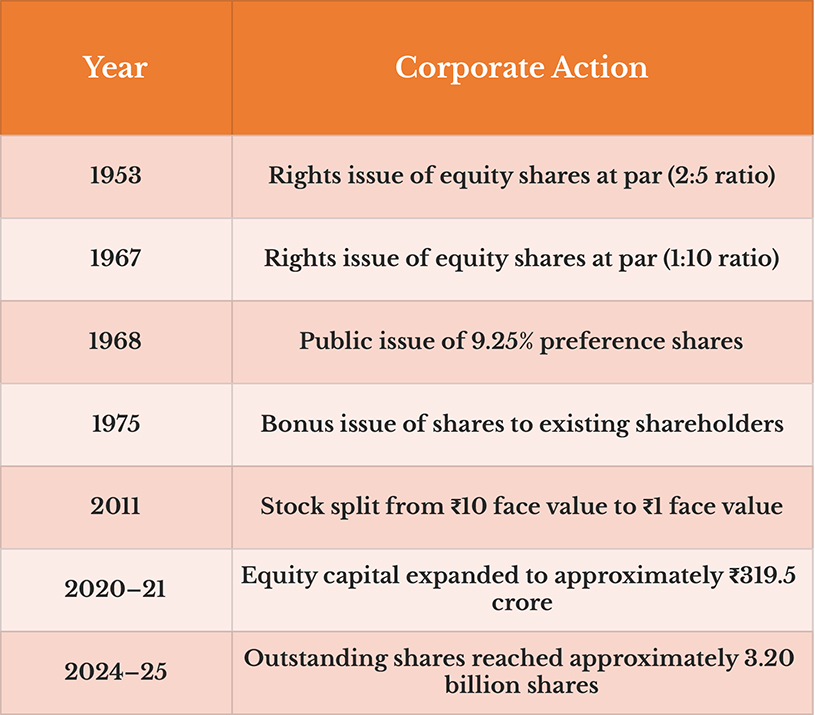
The share capital structure of Tata Power Company Limited has evolved significantly over its long operating history, reflecting its growth, expansion projects, and capital-raising initiatives. The company has periodically issued rights shares, bonus shares, and preference shares to fund infrastructure development and power generation projects. Historical records show that Tata Power issued rights equity shares in 1953 and 1967, offered preference shares to the public in 1968, and subsequently issued bonus shares in 1975 to reward existing shareholders. These corporate actions helped broaden the company's shareholder base while supporting its long-term capital requirements.

In more recent decades, Tata Power's equity base expanded substantially through share issuances and corporate restructuring. The company's paid-up equity capital increased from approximately ₹198 crore in 2006–07 to ₹215 crore by 2007–08 and continued growing thereafter. A major corporate action occurred in 2011 when the face value of the company's shares was split from ₹10 per share to ₹1 per share, increasing the number of outstanding shares tenfold while leaving the overall paid-up capital unchanged. By FY 2024–25, Tata Power had approximately 3.20 billion equity shares outstanding, with a paid-up equity capital of about ₹319.5 crore. The company's authorized capital also increased significantly over time, reaching ₹10,565 crore to support future fundraising and expansion plans.

Key Milestones in Tata Power's Share Capital History

Overall, Tata Power's share issuance history reflects the company's transition from a regional electricity supplier to one of India's largest integrated power companies, with its capital structure expanding alongside its investments in thermal, hydroelectric, renewable energy, transmission, distribution, and EV charging infrastructure.

Why are unclaimed shares of Tata Power Company Limited transferred to IEPF?

Unclaimed shares are transferred to the Investor Education and Protection Fund (IEPF) in accordance with Section 124(6) of the Ministry of Corporate Affairs and the IEPF Rules, 2016. The purpose is to safeguard the interests of investors and prevent shares from remaining indefinitely inactive or unattended.

Under Indian regulations, if dividends declared on shares remain unclaimed for seven consecutive years, the company is required to transfer the corresponding shares to the IEPF Authority, along with the unpaid dividend amount. Before making the transfer, the company must notify the shareholder through letters, public notices, and website disclosures, providing an opportunity to claim the dividend and prevent the transfer.

The key reasons for transferring shares to the IEPF are:

  • To protect shareholder assets that have remained inactive for an extended period.

  • To create a centralized mechanism for tracking and recovering forgotten investments.

  • To reduce the risk of fraud, misuse, or unauthorized transactions involving dormant holdings.

  • To encourage investors and their heirs to update contact details and maintain active ownership records.

Importantly, the transfer to IEPF does not extinguish ownership rights. The original shareholder or their legal heirs can apply to the IEPF Authority to reclaim both the shares and the accumulated dividends by submitting the prescribed documentation and verification forms.

For companies such as Tata Power Company Limited, shares are transferred to the IEPF only when the statutory conditions regarding unclaimed dividends have been met for seven consecutive years. Once reclaimed through the prescribed process, the shares are transferred back to the rightful owner.

How to find old shares from IEPF

To locate your old or forgotten Tata Power Company Limited shares, you will need to contact the IEPF authority first. 

The list of documents you will need is as follows: 

  1. Entitlement Letter from the Company’s RTA

  2. Aadhaar Number

  3. Passport, OCI, PIO Card Number for NRIs

  4. PAN details

  5. CIN of the company

  6. Succession certificate/Probate/Will (if necessary)

  7. Copy of death certificate (if necessary)

  8. No objection certificate from other holders

  9. Indemnity Bond and Surety Affidavit

  10. Folio Number

  11. Demat account number 

  12. Bank account details 

The process for lost share recovery is as follows: 

  1. Confirm whether you have shares of Tata Power Company Limited from the Company’s RTA or Nodal Officer, the company’s official website, or the IEPF website. 

  2. Create an account on the MCA portal. 

  3. Fill up Form IEPF-5 on the MCA website. 

  4. After successfully filing Form IEPF-5, the claimant must send a physical copy of the form along with supporting documents to the company’s IEPF Nodal Officer or Registrar. The envelope should be clearly labelled “Claim for Refund from IEPF Authority.” The required documents generally include a signed copy of Form IEPF-5, the SRN acknowledgement receipt, original indemnity bond executed on appropriate non-judicial stamp paper, original advance stamped receipt signed by the claimant and witnesses, and proof of ownership such as share certificates or Demat transaction statements. Additional documents such as Aadhaar card, cancelled cheque, Demat client master list, and Passport/OCI/PIO documents (for NRIs and foreign nationals) must also be enclosed wherever applicable.

  5. Once the company receives the form, it will begin the verification process and prepare a report if all the documents are in order. The report will be sent to the IEPF authority.  

  6. The IEPF authority will verify the claims and pay out the unclaimed investments. 

The Bottom Line

Recovering lost, forgotten, or unclaimed shares of Tata Power Company Limited can be a lengthy process involving multiple authorities, extensive documentation, and strict compliance with IEPF procedures. 

Whether the shares belong to you or were inherited from a deceased family member, navigating the recovery process without professional assistance can often lead to delays and complications.

This is where Share Samadhan can help. As one of India's leading share recovery and investment retrieval service providers, Share Samadhan has extensive experience assisting investors in reclaiming shares, dividends, mutual funds, bank deposits, and other financial assets that have been transferred to the IEPF. 

With a dedicated team that understands the complexities of succession claims, transmission cases, duplicate share certificates, and IEPF recovery procedures, Share Samadhan has successfully helped clients recover investments worth more than ₹700 crore.

If you have discovered old Tata Power share certificates, suspect that your shares have been transferred to the IEPF, or are facing challenges in completing the recovery process, Share Samadhan can guide you through every step—from tracing the shares and preparing documentation to coordinating with the company, registrar, and IEPF authorities. 

Professional assistance can significantly simplify the process and improve the chances of a successful claim, helping you recover investments that may have remained forgotten for years.

Frequently Asked Questions

What is the procedure for the issue of a duplicate share certificate?

If your original share certificate has been lost, misplaced, stolen, torn, or damaged, you can apply for a duplicate share certificate through the company's Registrar and Transfer Agent (RTA). The process generally involves submitting a request letter, identity and address proof, PAN card details, an indemnity bond, an affidavit regarding the loss of shares, and any other documents requested by the company. Once the documents are verified and the prescribed formalities are completed, the company may issue a duplicate share certificate in place of the original.

Which is the best share recovery firm in Delhi?

Several firms offer share recovery services in Delhi, but investors often prefer experienced service providers with a proven track record in recovering shares, dividends, mutual funds, bank deposits, and IEPF claims. Share Samadhan is among the well-known share recovery firms in Delhi and has assisted clients in recovering investments worth more than ₹700 crore from the IEPF and other authorities. Before selecting any service provider, investors should evaluate their expertise, success rate, transparency, and client reviews.

How much do share recovery services cost?

The cost of share recovery services varies depending on the complexity of the case, the value of the investments involved, the availability of documents, and whether legal heirship or succession matters are involved. Most professional share recovery firms charge either a fixed consultation fee, a success-based fee, or a combination of both. It is advisable to discuss the fee structure in advance and obtain a clear understanding of all charges before engaging a service provider.

How can I find lost investments?

You can begin by checking old financial records, bank statements, Demat account statements, dividend warrants, and physical share certificates. If you suspect that your shares or dividends have been transferred to the Investor Education and Protection Fund (IEPF), you can search the IEPF database using the shareholder's name or company name. You may also contact the company's RTA, review dormant bank accounts, check with mutual fund registrars, and verify records maintained by financial institutions where investments may have been made.

What does “IEPF status pending for approval” mean?

When an investor files Form IEPF-5 to claim shares or dividends from the Investor Education and Protection Fund, the application goes through multiple stages of verification. The status "Pending for Approval" generally indicates that the claim has been received and is under review by the company, its RTA, or the IEPF Authority. During this stage, the submitted documents are verified to confirm the claimant's entitlement. Once the verification process is completed and the claim is approved, the shares and/or dividends will be transferred to the claimant. If additional documents or clarifications are required, the applicant may be contacted by the concerned authority.

0 Read More
How to Recover Lost, Forgotten, or Unclaimed Shares of Bosch Limited

How to Recover Lost, Forgotten, or Unclaimed Shares of Bosch Limited

26, Jun 2026

If you have just discovered that you are the legal owner of shares of Bosch Limited that are now with IEPF, then this blog is for you. You can recover your unclaimed shares and dividends easily through the lost funds recovery process. 

The process of share recovery is very difficult and may take a lot of time. You can make only one claim a year, so it is necessary that your claim be complete. To make a consolidated claim, you need to have several documents in order. If you are the legal heir and the original shareholder is deceased, then you need to prove that you are the legal heir through certain documents. All this work can take months, and many people give up hope of ever reclaiming their shares.

To solve this national problem of lost funds recovery, Share Samadhan was established 14 years ago. Share Samadhan is a leading share recovery firm in Delhi, helping individuals reclaim lost, forgotten, or unclaimed investments, including shares that have been transferred to the IEPF after dividends remain unclaimed for seven consecutive years.

With over 14 years of experience, Share Samadhan has assisted thousands of investors in filing consolidated IEPF claims and has facilitated the recovery of investments worth over ₹700 crore. The company also supports NRIs across 10+ countries, offering expert guidance through a dedicated team of Business Analysts and Account Managers who help ensure a smooth and properly documented IEPF claim process.

In this blog, we will tell you how you can recover your lost, forgotten, or unclaimed shares of Bosch Limited from IEPF. 

About Bosch Limited

Bosch Limited is the flagship company of the Bosch Group in India and one of the country's leading suppliers of technology and engineering solutions. Established in 1951, the company operates across diverse sectors including mobility solutions, industrial technology, consumer goods, and energy and building technology. With a strong focus on innovation, quality, and sustainability, Bosch Limited has played a significant role in supporting India's industrial and automotive growth for over seven decades. The company is headquartered in Bengaluru and forms an integral part of the global Bosch network.

Today, Bosch Limited is best known for its advanced automotive technologies, including fuel injection systems, automotive electronics, safety systems, and aftermarket solutions. As the flagship entity of the Bosch Group in India, it contributes substantially to the group's operations, supported by an extensive manufacturing and research network across the country. Bosch also operates one of its largest development centers outside Germany in India, enabling end-to-end engineering and technology solutions. Driven by its global philosophy of “Invented for Life,” the company continues to invest in digitalization, electrification, artificial intelligence, and sustainable technologies that improve everyday life while supporting industrial progress.

Historical Data on the Shares Issued by Bosch Limited

Bosch Limited has a long and distinguished history in the Indian capital markets. Incorporated in 1951 as Motor Industries Company Limited (MICO), the company was subsequently renamed Bosch Limited in 2008 to align with the global Bosch brand identity. Over the decades, Bosch Limited has built a strong reputation among investors through its consistent operational performance, technological leadership, and shareholder-friendly policies.

The company's equity shares are listed on the National Stock Exchange (NSE) and the Bombay Stock Exchange (BSE), where they have historically been regarded as a high-value, blue-chip industrial stock. Bosch Limited has undertaken various corporate actions over the years, including bonus issues, stock splits, and dividend distributions, contributing to shareholder value creation. The company has maintained a track record of rewarding investors through regular dividends, reflecting its strong financial position and commitment to long-term growth.

As part of the global Bosch Group, Bosch Limited benefits from strong technological expertise and a diversified business portfolio spanning automotive components, industrial technology, consumer goods, and energy solutions. These strengths have helped the company maintain investor confidence and achieve sustained market recognition. Historical shareholding patterns indicate significant promoter ownership by Robert Bosch GmbH, alongside participation from institutional and retail investors, making Bosch Limited one of the most closely followed engineering companies in India.

How to claim unclaimed dividends and shares of Bosch Limited

If you have just found old physical share certificates of Bosch Limited, or have lost them, we explain how to reclaim your lost shares. 

How to Recover Bosch Limited Shares and Dividends from the IEPF Authority

Check Whether Your Bosch Limited Shares and Dividends Have Been Transferred to the IEPF Authority

Before initiating an IEPF claim, you must first determine whether your Bosch Limited shares or unpaid dividends have been transferred to the Investor Education and Protection Fund (IEPF). 

Under the provisions of the Companies Act, 2013, any dividends that remain unclaimed for seven consecutive years, along with the corresponding shares, are required to be transferred to the IEPF Authority. Companies are also mandated to maintain and publish records of such transfers.

To verify your status, visit Bosch Limited's official website and navigate to the Investor Relations or IEPF section. The company periodically publishes details of shareholders whose dividends and shares have been transferred to the IEPF. You can search the records using your name, folio number, DP ID, or Client ID. If your details appear in these records, it indicates that your shares and/or dividends have already been transferred to the IEPF.

As an additional step, you may visit the IEPF Authority's official portal, where information relating to unclaimed dividends and transferred shares is available. You may also contact Bosch Limited's Registrar and Transfer Agent (RTA) or the designated IEPF Nodal Officer for confirmation of your shareholding status and guidance on the recovery process.

Gather the Required Documents for Filing an IEPF Claim

Once you have confirmed that your shares or dividends are held by the IEPF Authority, you will need to file Form IEPF-5 through the Ministry of Corporate Affairs (MCA) portal. If you do not already have an MCA account, create one before proceeding with the application.

Before completing the form, ensure that you have the following documents ready:

  • Entitlement Letter from Bosch Limited's RTA

  • Aadhaar Card

  • PAN Card

  • Passport, OCI Card, or PIO Card (where applicable)

  • Corporate Identification Number (CIN) of Bosch Limited

  • Folio Number and Demat Account Number

  • Bank Account Details

  • Indemnity Bond and Surety Affidavit

  • Succession Certificate, Probate, or Will (if claiming on behalf of a deceased shareholder)

  • Death Certificate and No Objection Certificate from legal heirs, where applicable

File Form IEPF-5 on the MCA Portal

After creating your MCA account and gathering all required documents, complete and submit Form IEPF-5 online. Ensure that all information provided matches the company's records to avoid delays in processing your claim.

Submit Physical Documents to Bosch Limited

After successfully submitting Form IEPF-5 online, print a copy of the completed form and send it, along with the supporting documents, to Bosch Limited's IEPF Nodal Officer or its Registrar and Transfer Agent. The envelope should be clearly marked "Claim for Refund from IEPF Authority."

Your physical submission should generally include:

  • Signed copy of Form IEPF-5

  • SRN acknowledgement generated after online submission

  • Original Indemnity Bond executed on appropriate non-judicial stamp paper

  • Original Advance Stamped Receipt signed by the claimant and two witnesses

  • Proof of share ownership, such as physical share certificates or Demat transaction statements

  • Self-attested copy of Aadhaar Card

  • Cancelled cheque bearing the claimant's name

  • Demat Client Master List

  • Passport, OCI Card, or PIO Card (for NRIs and foreign nationals)

Verification by Bosch Limited and Processing by the IEPF Authority

Upon receipt of your application and supporting documents, Bosch Limited will verify the claim and review the submitted records. The company is required to complete its verification process and submit a verification report to the IEPF Authority within the prescribed timelines.

After receiving the verification report, the IEPF Authority conducts its own review of the claim. If all documents are found to be satisfactory and the claim is approved, a refund sanction order is issued. The approved dividend amount is credited directly to the claimant's registered bank account, while the recovered shares are electronically transferred to the claimant's Demat account.

Once the process is completed successfully, ownership of the shares and any eligible dividends is restored to the rightful shareholder or legal heir.

Conclusion

Share Samadhan helps investors reclaim their rightful investments from the IEPF through a streamlined and professionally managed share recovery process. Our experienced team guides you through every stage of the claim, ensuring that all documentation is accurate, complete, and compliant with regulatory requirements.

A dedicated Account Manager will be assigned to your case to assist with document collection, verification, and claim preparation. By helping you avoid common errors and preparing a well-documented consolidated claim, we work to minimize delays and improve the chances of a smooth recovery process. Contact Share Samadhan today to begin recovering your unclaimed shares and dividends with our share recovery services. 

Frequently Asked Questions 

What is the process for obtaining a duplicate share certificate?

If your share certificate has been lost, stolen, misplaced, mutilated, or damaged, you can request a duplicate share certificate from the company's Registrar and Transfer Agent (RTA). Typically, the process requires you to submit an application along with supporting documents such as proof of identity and address, PAN details, an indemnity bond, an affidavit explaining the loss or damage, and any additional documents specified by the company. After the company verifies the submitted information and completes the necessary formalities, a duplicate share certificate may be issued in place of the original.

Which is a reputed share recovery firm in Delhi?

Delhi is home to several firms that specialize in recovering lost or unclaimed investments, including shares, dividends, mutual funds, fixed deposits, and IEPF-related claims. Share Samadhan is one of the recognized names in this field, with extensive experience in assisting investors through complex recovery processes. The firm has helped recover investments worth over ₹700 crore and provides support for IEPF claims, transmission cases, duplicate share certificates, and other investment recovery matters. Before choosing any service provider, it is advisable to assess their experience, client feedback, transparency, and track record.

What are the charges for share recovery services?

The fees for share recovery services can vary based on factors such as the complexity of the case, the value of the assets being recovered, the availability of supporting documents, and whether legal heir or succession-related procedures are involved. Service providers may charge a fixed fee, a success-based fee, or a combination of both. To avoid any misunderstandings, investors should discuss the fee structure in detail and obtain complete clarity regarding the applicable charges before proceeding with the engagement.

0 Read More
Insurance Claim Missing Money IEPF Claim Lost Share
​

Find Your Missing Money!

  • Don’t Know the Missing / Lost or forgotten Investment ?
  • Please give your brief information
  • We will search for you/your family’s Investment
  • We will not charge any fee for basic search (FREE for Limited period )​

Choose Investment to be searched