- Sign In
- 8800 33 2200
- samadhan@sharesamadhan.com
- Sharesamadhan App
- Sharesamadhan App

Blog Details
How to Recover Lost, Forgotten, and Unclaimed Shares of United Spirits Limited
26, Aug 2026

United Spirits Limited (USL) is one of India's leading beverage alcohol companies and a prominent manufacturer, marketer, and distributor of premium spirits. With a diverse portfolio that includes whisky, vodka, rum, gin, and brandy, the company has established a strong presence across domestic and international markets.
Headquartered in Bengaluru, United Spirits has built a legacy spanning decades and is known for several iconic brands that have become household names in India. The company operates an extensive manufacturing and distribution network, serving millions of consumers across the country. As part of the global beverage leader Diageo, United Spirits combines international expertise with a deep understanding of the Indian market.
As a publicly listed company, United Spirits Limited has a large shareholder base. Over the years, due to reasons such as change of address, lost share certificates, unclaimed dividends, inactive Demat accounts, or lack of awareness among legal heirs, many investors have lost track of their shareholdings.
In such cases, shares and dividends may eventually be transferred to the Investor Education and Protection Fund (IEPF), if they remain unclaimed for the prescribed period. Fortunately, eligible shareholders and their legal heirs can initiate the recovery process by following the applicable regulatory procedures.
Historical Data on the Shares Issued by United Spirits Limited
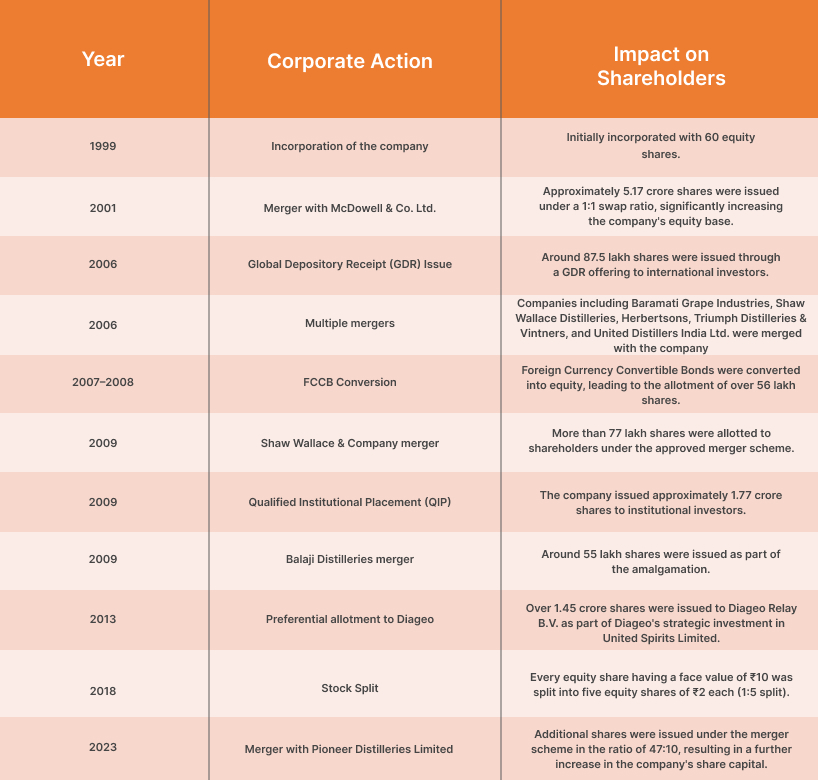
Understanding the share capital history of United Spirits Limited (USL) is essential for shareholders who are trying to recover lost, forgotten, or unclaimed shares. Over the years, the company has undergone several mergers, allotments, share issuances, and corporate restructuring exercises that have significantly changed the number of shares in circulation. Investors holding old physical share certificates may find that the number of shares they originally owned has changed because of these corporate actions.
Below is an overview of some of the major milestones in the company's share capital history:
Why This Matters for United Spirits Limited Shareholders
Many investors purchased United Spirits shares decades ago when share certificates were issued in physical form. Since then, the company's mergers, share issuances, and the 2018 stock split may have altered the number of shares they are entitled to today. If these shares were never dematerialized, dividends remained unclaimed for seven consecutive years, or investors lost track of their holdings, the shares may have been transferred to the Investor Education and Protection Fund (IEPF).
Before initiating an IEPF claim or requesting duplicate share certificates, shareholders should carefully verify their original folio number, share certificate details, and any corporate actions that may have affected their holdings. Having a clear understanding of United Spirits Limited's share history can make the recovery process significantly smoother and help ensure that the correct number of shares is claimed.
Billions in Unclaimed Investments Are Waiting to Be Recovered
A substantial amount of investor wealth remains unclaimed with the Investor Education and Protection Fund (IEPF). As per the latest available data, the IEPF Authority holds over 117 crore unclaimed shares and more than ₹8,200 crore in unpaid dividends belonging to investors and their legal heirs.
If dividends on your shares have remained unclaimed for seven consecutive years, your shares may have been transferred to the IEPF in accordance with regulatory requirements. The good news is that these investments can still be recovered. By understanding the IEPF claim process and following the necessary steps, eligible shareholders and legal heirs can reclaim their unclaimed shares and dividends.
How to Recover Lost, Forgotten, and Unclaimed Shares of United Spirits Limited
Check Whether Your Shares Have Been Transferred to the IEPF
The first step is to verify whether your United Spirits Limited shares have been transferred to the Investor Education and Protection Fund (IEPF). Under the Companies Act, 2013, shares and unpaid dividends are transferred to the IEPF if dividends remain unclaimed for seven consecutive years. Once transferred, you must file an IEPF claim with the IEPF Authority to recover your shares and dividends, as the company can no longer process the claim directly.
How to Check if Your United Spirits Limited Shares Have Been Transferred to the IEPF
To verify whether your United Spirits Limited shares have been transferred to the Investor Education and Protection Fund (IEPF), visit the company's Investor Relations section, where it periodically publishes the list of shareholders whose unpaid dividends and corresponding shares have been transferred to the IEPF Authority. You can search the records using your name, folio number, DP ID, or Client ID. If your details appear in the list, it means your shares and any associated unpaid dividends have been transferred to the IEPF.
You can also verify the status of your unclaimed shares and dividends through the IEPF Authority's online portal. If you require further assistance, you may contact United Spirits Limited's Registrar and Transfer Agent (RTA) or the company's IEPF Nodal Officer. They can help confirm the transfer status and guide you through the process of recovering your shares and unpaid dividends from the IEPF.
Gather the Required Documents for Your IEPF Claim
Before filing an IEPF claim for your United Spirits Limited shares, ensure that you have the necessary documents ready. Depending on the nature of your claim, you may need:
- Entitlement Letter issued by United Spirits Limited or its Registrar and Transfer Agent (RTA)
- Aadhaar Card
- PAN Card
- Passport, OCI Card, or PIO Card (where applicable)
- Corporate Identification Number (CIN) of United Spirits Limited
- Folio Number and Demat Account details
- Bank account details (cancelled cheque or passbook copy, if required)
- Indemnity Bond and Affidavit
- Original share certificate(s), if available
- Succession Certificate, Probate, or Will (for claims by legal heirs)
- Death Certificate of the shareholder (where applicable)
- No Objection Certificates (NOCs) from other legal heirs, if applicable
Keeping these documents complete and accurate before initiating your claim can help streamline the IEPF recovery process and minimize delays.
Submit Form IEPF-5 on the MCA Portal
After gathering the required documents, file Form IEPF-5 through the MCA portal to initiate your claim for United Spirits Limited shares. Ensure that all details—including your name, folio number, DP ID/Client ID, bank account information, and shareholding details—accurately match the records maintained by the company and its Registrar and Transfer Agent (RTA).
Review the form carefully before submission, as any discrepancies may result in delays or additional documentation requests.
Send the Physical Documents to United Spirits Limited
After submitting Form IEPF-5 online, print the completed form and send it along with the required supporting documents to the IEPF Nodal Officer of United Spirits Limited or its Registrar and Transfer Agent (RTA). Mention "Claim for Refund from IEPF Authority" on the envelope for easy identification.
The document set generally includes:
- Duly signed copy of Form IEPF-5
- SRN acknowledgement generated after online submission
- Original Indemnity Bond
- Original Advance Stamped Receipt
- Proof of share ownership (physical share certificates or Demat account statement)
- Self-attested copies of Aadhaar Card and PAN Card
- Cancelled cheque or bank passbook copy
- Demat Client Master List (CML), where applicable
- Passport, OCI Card, or PIO Card (for NRI/foreign claimants)
- Succession documents, death certificate, or other legal documents, if applicable
Before dispatching the documents, ensure that they are complete, signed, and self-attested wherever required. It is also advisable to keep copies of the entire document set and the courier or postal receipt for future reference.
Verification by United Spirits Limited and Processing by the IEPF Authority
Once your physical documents are received, United Spirits Limited and its Registrar and Transfer Agent (RTA) verify the details against the company's shareholder records. After successful verification, a verification report is submitted to the Investor Education and Protection Fund (IEPF) Authority for further processing.
The IEPF Authority then reviews the claim and supporting documents. If everything is found to be in order, it approves the claim and authorizes the release of the shares and any eligible unpaid dividends.
Upon approval, the recovered shares are credited to the claimant's Demat account, while the approved dividend amount is transferred directly to the registered bank account. Since the IEPF recovery process involves multiple documents and strict compliance requirements, many investors seek professional assistance to ensure accurate filing and avoid unnecessary delays.
Why Consider Professional Share Recovery Services?
Recovering shares from the IEPF can be a lengthy and document-intensive process. Even minor issues—such as name discrepancies, signature mismatches, outdated records, or incomplete documentation—can delay the processing of your claim.
The process can be even more complex for legal heirs claiming shares on behalf of a deceased shareholder. In such cases, additional documents, such as succession certificates, probate, legal heir certificates, or other supporting records, may be required. If any of these documents are missing or need to be reissued, the recovery process can take significantly longer.
Professional share recovery services can help assess the eligibility of your claim, identify documentation gaps, coordinate with the company and its Registrar and Transfer Agent (RTA), and ensure that your IEPF application is complete and accurate. Since investors can typically submit only one IEPF claim per company in a financial year, filing a well-prepared claim can help minimize delays and improve the chances of a successful recovery.
Conclusion
Recovering lost, forgotten, or unclaimed investments can be a complex process, especially when it involves IEPF claims, missing documents, legal heir cases, or old physical share certificates. Rather than navigating multiple procedures on your own, you can rely on the expertise of Share Samadhan, one of India's leading share recovery firms.
Our experienced team assists investors and legal heirs with a wide range of share recovery services, including:
- Recovery of shares transferred to the IEPF
- Lost and forgotten share recovery
- Duplicate share certificate issuance
- Transfer and transmission of shares
- Dematerialisation of physical shares
- Recovery of unpaid dividends
- Share tracing and ownership verification
When you contact Share Samadhan, our experts first evaluate your case to determine the best course of action. If your case is accepted, you will be assigned a Dedicated Relationship Manager who will guide you through every stage of the recovery process—from document collection and verification to filing the claim and coordinating with the company, its Registrar and Transfer Agent (RTA), and the IEPF Authority.
We also specialize in assisting Non-Resident Indians (NRIs). Whether your shares are lying with the IEPF, or you need duplicate share certificates, or you want to trace old investments, our team can manage the process remotely. In most cases, NRIs do not need to travel to India, as the documentation, coordination, and claim process can be handled efficiently through online and courier-based communication.
If you believe you or your family owns lost, forgotten, or unclaimed United Spirits Limited shares, don't let your investments remain idle. Reach out to Share Samadhan today and let our experts help you reclaim what rightfully belongs to you.
Frequently Asked Questions (FAQs)
1. How can I convert my physical share certificates into Demat form?
To dematerialize your physical shares, you need to open a Demat account with a registered Depository Participant (DP) and submit a Dematerialisation Request Form (DRF) along with your original share certificates. If there are discrepancies in the records, professional assistance can help resolve them and complete the process smoothly.
2. I have lost track of my old share investments. Can they still be traced?
Yes. Even if you have misplaced your share certificates or forgotten your investments, old shares can often be traced using details such as your name, PAN, folio number, or other available records. Once identified, the appropriate recovery process can be initiated.
3. How do I recover shares that have been transferred to the IEPF?
If your dividends remained unclaimed for seven consecutive years, your shares may have been transferred to the Investor Education and Protection Fund (IEPF). You can recover them by filing Form IEPF-5, submitting the required documents, and completing the verification process with the company and the IEPF Authority.
4. What should I do if my physical share certificate is lost or damaged?
If your original share certificate has been lost, stolen, or damaged, you can apply for a duplicate share certificate through the company or its Registrar and Transfer Agent (RTA). The process typically requires identity proof, an indemnity bond, and other supporting documents.
5. What is the difference between transfer and transmission of shares?
Transfer of shares is the voluntary transfer of ownership from one living person to another, usually through a sale or gift. Transmission of shares, on the other hand, occurs due to the death of a shareholder, where the shares are transferred to the legal heir or nominee after the required legal formalities are completed.
What is the procedure for share transmission?
Share transmission is the process by which the ownership of shares is transferred to a nominee or legal heir following the death of a shareholder. Since it occurs by operation of law, it does not require a share transfer deed.
The procedure for share transmission generally involves the following steps:
- 1. Notify the Company or RTA:
The nominee or legal heir should inform the company or its Registrar and Transfer Agent (RTA) about the shareholder's death and request the prescribed transmission application form. - 2. Collect the Required Documents:
The claimant must gather all the documents needed to support the request. These usually include the death certificate of the shareholder, the original share certificate (for physical shares), identity and address proof of the claimant, and legal documents such as a succession certificate, probate of will, legal heir certificate, or letters of administration, depending on the case. The company may also ask for an affidavit, indemnity bond, or other supporting documents. - 3. Submit the Transmission Request:
The completed transmission form, along with all required documents, should be submitted to the company or its RTA for processing. - 4. Verification of the Claim:
The company examines the documents to confirm the claimant's identity and legal entitlement to the shares. If any information is missing or additional proof is required, the claimant may be asked to provide further documents. - 5. Approval of the Transmission:
Once the verification process is completed successfully, the company approves the request and records the name of the nominee or legal heir as the new shareholder in its Register of Members. - 6. Update of Shareholding Records:
After approval, the company updates its records and completes the transmission. For shares held in physical form, a new share certificate may be issued in the name of the claimant. If the shares are held in demat form, they are credited to the claimant's demat account.
The exact documentation and requirements may vary depending on the company's policies, the value of the shares, and whether the deceased shareholder had appointed a nominee or left a valid will.
How to claim unclaimed dividend?
If you have an unpaid or unclaimed dividend, you can recover it by following the prescribed process. The steps vary depending on whether the dividend is still with the company or has already been transferred to the Investor Education and Protection Fund (IEPF). Unclaimed dividends for 7 consecutive years are transferred to the IEPF.
1. Verify Whether the Dividend Is Unclaimed
Start by checking whether any dividend is pending in your name. You can do this using your Folio Number (for physical shares) or DP ID and Client ID (for demat shares) on the Registrar and Transfer Agent's (RTA) investor portal.
2. Submit a Request to the Company or RTA
If the dividend has not yet been transferred to the IEPF, submit a claim to the company's Registrar and Transfer Agent. Your application should include details such as your shareholder information, folio number or demat account details, the relevant financial year, and your contact information.
3. Provide the Required Documents
To process your request, you will generally need to submit supporting documents, including:
- A self-attested copy of your PAN card.
- A cancelled cheque with your name printed on it for bank verification.
- Client Master List (for shares held in demat form), if applicable.
- Any additional forms or declarations required under the applicable SEBI guidelines.
4. Verification of the Claim
After receiving your application, the company or its RTA will verify the details and supporting documents. If all information is accurate and complete, your claim will be approved for payment.
5. Receive the Dividend
Once the verification is completed, the unpaid dividend is credited to your registered bank account or paid through the mode specified by the company.
6. If the Dividend Has Been Transferred to the IEPF
When a dividend remains unclaimed for seven consecutive years, it is transferred to the Investor Education and Protection Fund (IEPF) along with the related shares. In such cases, the claim must be filed with the IEPF Authority by submitting Form IEPF-5 along with the required supporting documents. The company will verify the claim before the IEPF Authority processes the refund.
Tip: Keep your PAN, bank account details, email address, mobile number, and nomination details updated with your company or depository participant. This helps ensure that future dividends are credited on time and do not become unclaimed.
How to find lost investments?
Many investors lose track of their investments over time due to changes in address, forgotten folio numbers, misplaced share certificates, or the death of the original investor. Fortunately, these investments can often be traced with the right approach.
Here are the steps to find lost investments:
1. Gather Available Information
Start by collecting any details you have about the investment, such as:
- Name of the company.
- Old share certificates or dividend warrants.
- Folio number or shareholder reference number.
- PAN, Aadhaar, or other identity documents.
- Bank statements showing dividend credits.
Even partial information can help in locating the investment.
2. Check Your Demat Account
If your shares have been dematerialised, log in to your demat account to view your current holdings. Your depository participant (DP) can also help you access your investment records.
3. Contact the Company's Registrar and Transfer Agent (RTA)
If you believe the shares are still held in physical form, contact the company's Registrar and Transfer Agent (RTA). Provide your available details, such as your name, PAN, or folio number, to help them trace your records.
4. Search for Unclaimed Shares and Dividends
Many companies publish details of unclaimed shares and dividends on their websites. You can also check the Investor Education and Protection Fund (IEPF) portal to see if your shares or dividends have been transferred to the IEPF after remaining unclaimed for several years.
5. Review Old Financial Records
Look through old income tax returns, bank statements, investment files, dividend warrants, or correspondence from companies. These documents often contain valuable information, such as company names, folio numbers, or transaction details.
6. Check with Depositories
If you are unsure where your investments are held, you can contact your depository participant or check your records with the depositories where your securities are maintained.
7. Seek Professional Assistance
If the investment records are incomplete, the company has merged or changed its name, or the shares have been transferred to the IEPF, you may consider taking help from professionals who specialise in tracing and recovering lost investments like Share Samadhan.
Finding lost investments may take some time, but it is often possible with the right documents and proper verification. Keeping your contact details updated, maintaining digital records, and regularly reviewing your investment portfolio can help prevent investments from becoming unclaimed in the future.
How to find unclaimed shares?
Unclaimed shares are shares that have remained inactive for several years because the shareholder could not be contacted, dividends were not claimed, or the shares were transferred to the Investor Education and Protection Fund (IEPF). If you think you have forgotten or inherited investments, you can trace them by following these steps.
1. Search Your Investment Records
Begin by checking any documents related to your investments, such as:
- Old share certificates.
- Dividend warrants.
- Demat account statements.
- Bank statements showing dividend payments.
- Income tax records or investment files.
These documents may contain important details like the company name or folio number.
2. Contact the Company or Its Registrar and Transfer Agent (RTA)
If you know the company in which the shares were purchased, contact its Registrar and Transfer Agent (RTA). By providing your name, PAN, folio number, or other available information, the RTA may be able to locate your shareholding records.
3. Check Your Demat Account
If the shares have already been converted into electronic form, log in to your demat account to review your holdings. Your depository participant (DP) can also help you verify your investments.
4. Search the IEPF Database
If dividends on the shares have remained unclaimed for seven consecutive years, both the unpaid dividends and the related shares may have been transferred to the Investor Education and Protection Fund (IEPF). You can search the IEPF records using your name or the company's details to determine whether your shares have been transferred.
5. Verify Corporate Changes
If the company has merged, changed its name, or been acquired, your shares may now be held under a different company name. Checking the company's corporate history can help you trace your investment.
6. Recover the Shares
Once you locate the unclaimed shares, follow the company's or the IEPF Authority's prescribed process to reclaim them. You may be required to submit identity proof, ownership documents, and other supporting records for verification.
Tracing unclaimed shares is easier when you have supporting documents, but even if some records are missing, you may still be able to recover your investments by contacting the company, its RTA, or the IEPF Authority. Keeping your contact details, PAN, bank information, and nomination details updated can help prevent your shares from becoming unclaimed in the future.
How to Find Old Shares of a Deceased Relative?
If a family member has passed away, they may have left behind investments that are unknown to the legal heirs. These old shares can often be traced, even if the original documents are missing. By following the right process, you can identify and recover the investments legally.
1. Search Through Personal Documents
Start by checking the deceased person's financial records, including:
- Old share certificates.
- Dividend warrants.
- Bank statements showing dividend credits.
- Income tax returns.
- Investment files or correspondence from companies.
These records may contain details such as the company name, folio number, or shareholder information.
2. Check Demat Account Details
If the deceased held shares in electronic form, identify their demat account. The depository participant (DP) can provide information about the holdings after verifying the legal heir's identity and supporting documents.
3. Contact the Company's Registrar and Transfer Agent (RTA)
If you know the name of the company, approach its Registrar and Transfer Agent (RTA). Provide the deceased shareholder's name, PAN, address, or any available folio number. The RTA can help verify whether shares are registered in their name.
4. Search for Unclaimed Shares
If the shares remained inactive and dividends were not claimed for several years, they may have been transferred to the Investor Education and Protection Fund (IEPF). Legal heirs can search the IEPF records using the deceased shareholder's details to determine whether the shares have been transferred.
5. Check for Corporate Changes
Many companies have merged, changed their names, or undergone restructuring over the years. If the original company no longer exists under the same name, trace its successor company to locate the shares.
6. Gather Legal Documents
To claim the shares, legal heirs generally need documents such as:
- Death certificate of the shareholder.
- Identity and address proof of the claimant.
- Legal heir certificate, succession certificate, probate of will, or letters of administration, depending on the circumstances.
- Original share certificates, if available.
- Any additional documents required by the company or its RTA.
7. Complete the Share Transmission Process
Once the shares are located, the legal heir must apply for share transmission. After the company verifies the documents, the shares are transferred to the rightful claimant's name or demat account.
Finding old shares of a deceased relative may require patience, especially if the investments are several years old or the records are incomplete. However, with the available financial documents, assistance from the company's RTA, and the required legal documents, legal heirs can trace and recover the investments through the prescribed transmission process.
What is an IEPF shares search?
An IEPF shares search is the process of checking whether shares have been transferred to the Investor Education and Protection Fund (IEPF). Under the Companies Act, if dividends on shares remain unclaimed for seven consecutive years, the corresponding shares are also transferred to the IEPF. Investors or their legal heirs can search the IEPF database using details such as the shareholder's name, company name, or folio number to determine whether any shares are held by the IEPF. If the shares are found, they can be claimed by following the prescribed IEPF recovery process and submitting the required documents.
India's largest & most trusted platform for recovery of unclaimed investments
Submit Your Query
Recent Posts
- How to Make an India Cements IEPF Claim
- How to Make an LIC Housing Finance IEPF Claim
- How to Make an IDBI Bank IEPF Claim ?
- How to Recover Reliance Infrastructure Unclaimed Shares from IEPF
- How to Make an IEPF Claim for Unclaimed DCB Bank Shares and Dividends
- How to Recover Lost, Forgotten, and Unclaimed Shares of Berger Paints India Ltd